Quick answer: Strength training (also called weight or resistance training) is any exercise that works your muscles against resistance — body weight, free weights, bands or machines — to build muscle, strength and endurance. Just 2–3 sessions a week improves your strength, bone density, metabolism and overall health, and you can start at any age or fitness level.
This guide covers what strength training is, its benefits, the best exercises to start with, how often to train, and how to progress safely.
What is strength training?
Strength training is any form of exercise that makes your muscles work against a weight or resistance. You’ll also hear it called weight training or resistance training — they all mean the same thing. The resistance can come from your own body weight, dumbbells and barbells, resistance bands, or machines. The goal is to build muscle mass, strength and endurance while improving bone density, metabolism and joint health.
Is pilates or yoga strength training?
Partly. Pilates and yoga build strength and stability using body weight, so they count as light resistance training — but they generally don’t provide the progressive loading needed to build significant muscle and strength. For real strength gains, you need to gradually increase the resistance over time (more on that below).
What are the benefits of strength training?
Strength training is one of the most effective things you can do for your body. Backed by research, the main benefits include:
- Builds muscle and strength — makes everyday tasks easier and keeps you strong as you age.
- Burns calories and body fat — muscle raises your resting metabolism, so you burn more even at rest.
- Stronger bones — increases bone density and helps protect against osteoporosis.
- Healthier joints and fewer injuries — stronger muscles support and stabilise your joints.
- Better heart health and blood sugar — improves cardiovascular health and insulin sensitivity.
- Improved mood, mental health and brain function.
- Greater mobility, balance and flexibility — and a lower risk of falls.
- Real-world functional strength — carrying, lifting and moving with confidence.
Types of strength training (and the equipment you can use)
You don’t need a huge setup to start. The main types of strength training are:
- Body weight — squats, push-ups, lunges and planks using your own mass.
- Free weights — dumbbells, barbells and kettlebells for the most versatile strength work.
- Resistance bands — portable elastic bands that add steady tension.
- Machines — fixed-path cable and weight machines, great for learning movements safely.
What is functional strength training?
Functional strength training focuses on movements you use in everyday life — squatting, hinging, pushing, pulling and carrying — rather than isolating single muscles. It builds strength that transfers directly to daily activities and sport, which is exactly how we train at The Gym Condell Park.
The best strength training exercises to start with
The most effective strength exercises are compound exercises — movements that work several muscle groups at once. They give you the most strength and muscle for your time.
| Exercise | Main muscles worked |
|---|---|
| Squat | Legs and glutes |
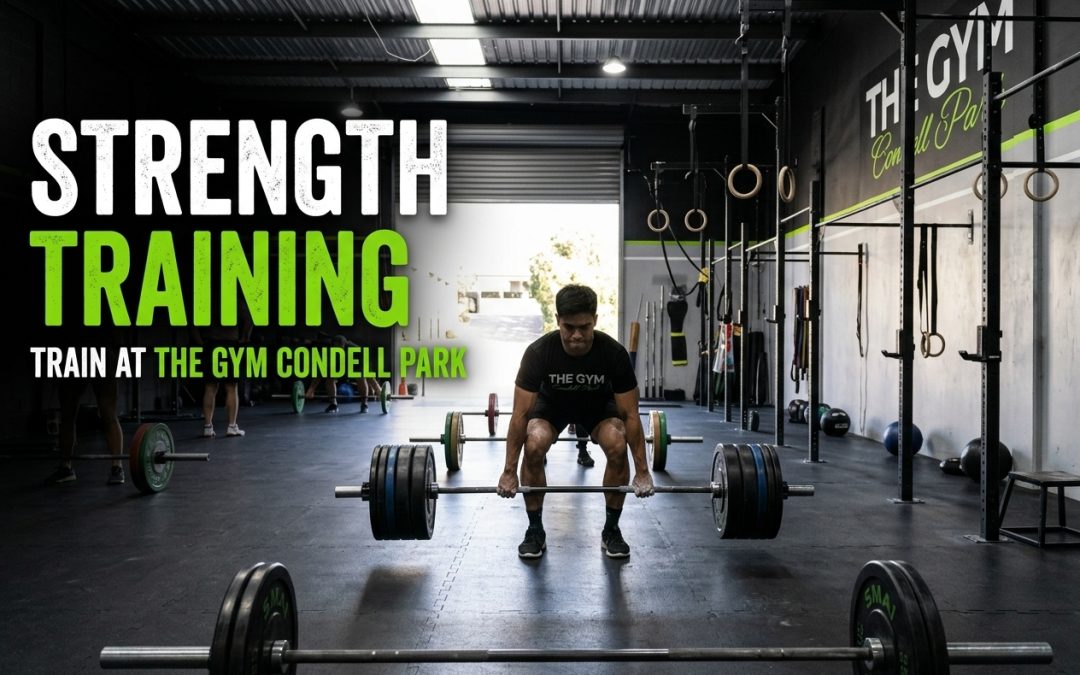
| Deadlift | Posterior chain (hamstrings, glutes, back) |
| Bench / overhead press | Chest, shoulders and arms |
| Row | Upper back and biceps |
| Push-up | Chest, shoulders and core |
| Plank | Core and stability |
If you’re brand new, start with the bodyweight versions — squats, push-ups, rows and planks — and add load as your technique improves.
How to start strength training safely (for beginners)
Getting started is simple if you build good habits from day one:
- Warm up for 5–10 minutes before you lift.
- Learn technique before adding weight — good form first, load later.
- Start light and progress gradually.
- Set clear, simple goals so you can track progress.
- Get coaching or a movement check if you’re unsure — it’s the fastest way to train safely and effectively.
How often should you strength train?
For most people, 2–3 strength sessions a week is the sweet spot, with a rest day in between to recover. Sessions can be as short as 20–45 minutes.
Is 20 minutes of strength training a day enough?
Yes — a focused 20-minute session built around compound exercises can absolutely build strength, especially for beginners. Consistency matters far more than session length.
Reps, sets and progressive overload
The single most important principle in strength training is progressive overload.
What is progressive overload?
Progressive overload means gradually increasing the demand on your muscles over time — by adding weight, reps or sets — so they keep adapting and getting stronger. Without it, progress stalls.
How many sets and reps should you do?
A good general guide for building strength and muscle is 3–4 sets of 6–12 reps per exercise, resting 1–2 minutes between sets. Beginners can start with 2–3 sets and focus on technique.
What is the 3-3-3 rule?
The “3-3-3 rule” is a simple beginner structure some gyms use — for example 3 exercises, 3 sets, 3 times a week — to keep training consistent and manageable. It’s a guide, not a strict rule; the key is progressing over time.
How long until you see results?
You’ll usually feel stronger and more energetic within 2–4 weeks. Visible muscle changes typically take around 8–12 weeks of consistent training and good nutrition. Strength improves faster than size, so expect your lifts to climb before your mirror changes.
Nutrition basics: how much protein for strength training?
Protein helps your muscles repair and grow. A common guideline for people strength training is around 1.6–2.2 g of protein per kilogram of body weight per day, spread across your meals. Eat enough overall food to support your training, stay hydrated, and treat supplements (like creatine) as extras — not replacements for good eating and training.
How to avoid injury while strength training
Most training injuries come from doing too much, too soon, with poor technique. To stay safe:
- Prioritise technique and control over heavy weight.
- Progress load gradually.
- Warm up and don’t skip mobility work.
- Some muscle soreness (DOMS) is normal; sharp pain is not — back off if something hurts.
Train strength with coaching at The Gym Condell Park
The fastest, safest way to get strong is with coaching, a plan and a community that keeps you consistent. At The Gym Condell Park, our coached strength & conditioning, CrossFit and Hyrox classes build real, functional strength — with a coach checking your technique every session and no lock-in memberships.
Take a look at our class timetable to find a session that suits you, or get in touch if you have any questions. New to it all? Read our guides on what HYROX is and CrossFit for beginners.
Ready to get stronger? Your first class is free — come and train with us just minutes from Bankstown and the surrounding suburbs.
Strength training FAQ
What are the 5 basic strength training exercises?
The squat, deadlift, bench press, overhead press and row — five compound movements that train the whole body.
Is 20 minutes of strength training a day enough?
Yes. A focused 20-minute session around compound exercises builds strength, especially for beginners. Consistency beats length.
What are good examples of strength training?
Squats, push-ups, lunges, rows, deadlifts, presses and planks — using body weight, dumbbells, barbells, kettlebells, bands or machines.
What is the 3-3-3 rule at the gym?
A simple beginner framework — commonly 3 exercises, 3 sets, 3 times a week — to keep training consistent while you build the habit.
How many days a week should I strength train?
2–3 days a week for most people, with rest days in between to recover and adapt.
Is pilates or yoga strength training?
They build strength and stability, but usually lack the progressive loading needed for big strength and muscle gains — great as a complement, not a full replacement.
How long does it take to build muscle?
You’ll feel stronger in 2–4 weeks; visible muscle usually takes 8–12 weeks of consistent training and good nutrition.
Written by the coaching team at The Gym Condell Park — CrossFit, HYROX and strength & conditioning in Condell Park, Sydney. Last updated: August 2026.